Documentation Index
Fetch the complete documentation index at: https://wb-21fd5541-john-wbdocs-2044-rename-serverless-products.mintlify.app/llms.txt
Use this file to discover all available pages before exploring further.
LLM 기반 애플리케이션에는 모니터링이 중요한 여러 LLM call, 추가적인 데이터 처리, 그리고 검증 로직이 포함될 수 있습니다. 이러한 중첩 함수와 그 부모-자식 관계는 Python에서는 @weave.op() 데코레이터를 사용하고, TypeScript에서는 weave.op()로 감싸서 Weave에서 추적할 수 있습니다.
애플리케이션의 전체 실행 흐름을 포착할 수 있도록 함수와 하위 함수를 가능한 한 세분화해 데코레이션하는 것을 권장합니다. 이렇게 하면 애플리케이션의 동작을 더 잘 이해하고 원하는 방식으로 조정하는 데 도움이 됩니다.
다음 코드는 퀵스타트 예제를 바탕으로, LLM이 반환한 항목 수를 세고 이를 더 상위 수준의 함수로 감싸는 로직을 추가합니다. 또한 이 예제에서는 weave.op()를 사용해 모든 함수와 그 call 순서, 그리고 부모-자식 관계를 트레이스합니다:
import weave
import json
from openai import OpenAI

client = OpenAI()

@weave.op()
def extract_dinos(sentence: str) -> dict:
    response = client.chat.completions.create(
        model="gpt-4o",
        messages=[
            {
                "role": "system",
                "content": """Extract any dinosaur `name`, their `common_name`, \
names and whether its `diet` is a herbivore or carnivore, in JSON format."""
            },
            {
                "role": "user",
                "content": sentence
            }
            ],
            response_format={ "type": "json_object" }
        )
    return response.choices[0].message.content

@weave.op()
def count_dinos(dino_data: dict) -> int:
    # 반환된 목록의 항목 수를 센다
    k = list(dino_data.keys())[0]
    return len(dino_data[k])

@weave.op()
def dino_tracker(sentence: str) -> dict:
    # LLM을 사용해 공룡을 추출한다
    dino_data = extract_dinos(sentence)

    # 반환된 공룡 수를 센다
    dino_data = json.loads(dino_data)
    n_dinos = count_dinos(dino_data)
    return {"n_dinosaurs": n_dinos, "dinosaurs": dino_data}

weave.init('jurassic-park')

sentence = """I watched as a Tyrannosaurus rex (T. rex) chased after a Triceratops (Trike), \
both carnivore and herbivore locked in an ancient dance. Meanwhile, a gentle giant \
Brachiosaurus (Brachi) calmly munched on treetops, blissfully unaware of the chaos below."""

result = dino_tracker(sentence)
print(result)
extract_dinos와 count_dinos)의 입력과 출력이 표시되고, 자동으로 로깅된 OpenAI 트레이스도 함께 표시됩니다.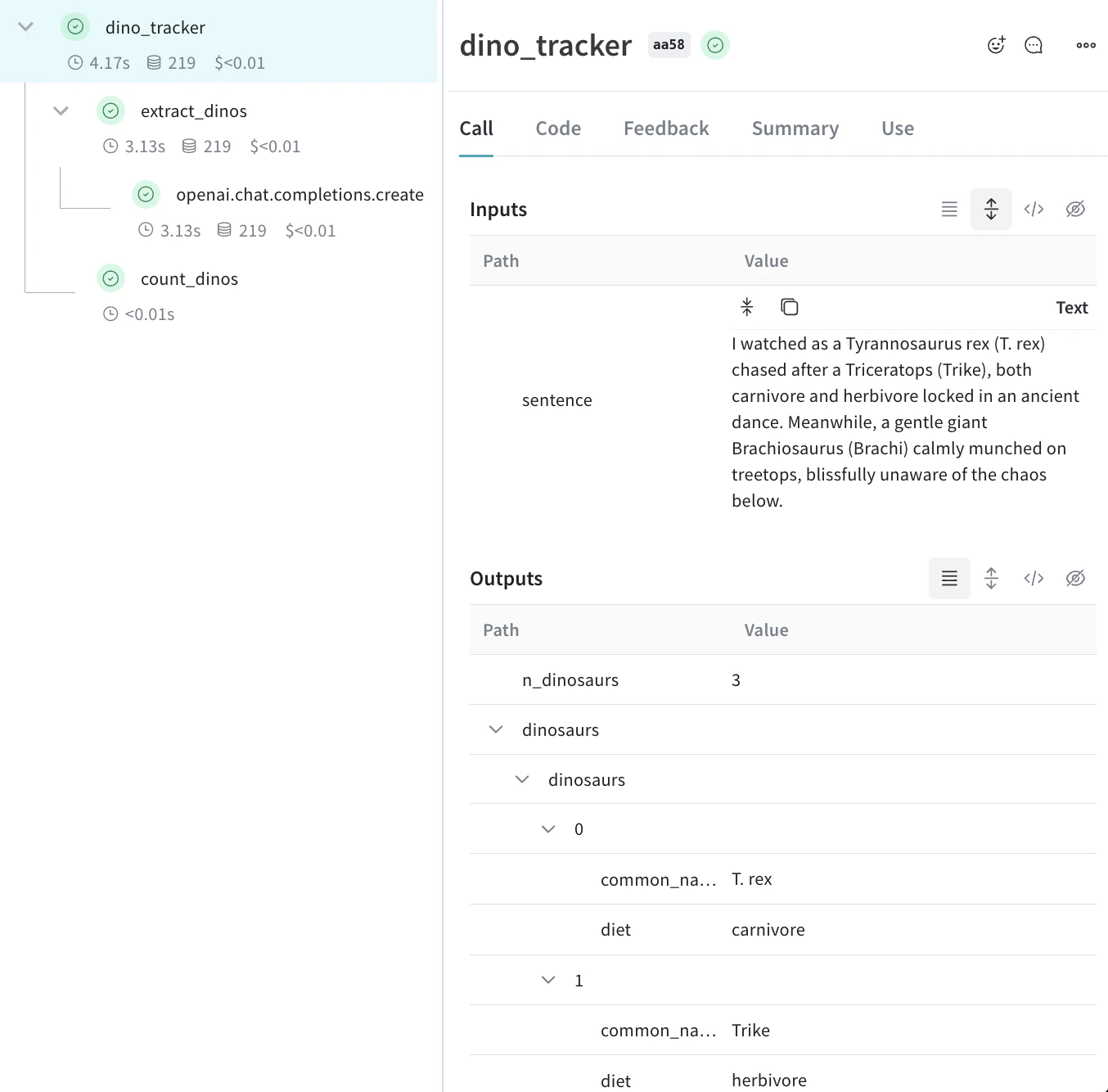
import OpenAI from 'openai';
import * as weave from 'weave';

const openai = new OpenAI();

const extractDinos = weave.op(async (sentence: string) => {
  const response = await openai.chat.completions.create({
    model: 'gpt-4o',
    messages: [
      {
        role: 'system',
        content:
          'Extract any dinosaur `name`, their `common_name`, names and whether its `diet` is a herbivore or carnivore, in JSON format.',
      },
      {role: 'user', content: sentence},
    ],
    response_format: {type: 'json_object'},
  });
  return response.choices[0].message.content;
});

const countDinos = weave.op(async (dinoData: string) => {
  const parsed = JSON.parse(dinoData);
  return Object.keys(parsed).length;
});

const dinoTracker = weave.op(async (sentence: string) => {
  const dinoData = await extractDinos(sentence);
  const nDinos = await countDinos(dinoData);
  return {nDinos, dinoData};
});

async function main() {
  await weave.init('jurassic-park');

  const sentence = `I watched as a Tyrannosaurus rex (T. rex) chased after a Triceratops (Trike),
        both carnivore and herbivore locked in an ancient dance. Meanwhile, a gentle giant
        Brachiosaurus (Brachi) calmly munched on treetops, blissfully unaware of the chaos below.`;

  const result = await dinoTracker(sentence);
  console.log(result);
}

main();
extract_dinos와 count_dinos)의 입력과 출력이 표시되고, 자동으로 로깅된 OpenAI 트레이스도 함께 표시됩니다.weave.attributes 컨텍스트 관리자를 사용해, 호출 시점에 추적할 메타데이터를 딕셔너리로 전달하면 메타데이터를 추적할 수 있습니다.
앞선 예제를 이어서 보겠습니다:
import weave

weave.init('jurassic-park')

sentence = """I watched as a Tyrannosaurus rex (T. rex) chased after a Triceratops (Trike), \
both carnivore and herbivore locked in an ancient dance. Meanwhile, a gentle giant \
Brachiosaurus (Brachi) calmly munched on treetops, blissfully unaware of the chaos below."""

# 이전에 정의한 함수와 함께 메타데이터 추적
with weave.attributes({'user_id': 'lukas', 'env': 'production'}):
    result = dino_tracker(sentence)
이 기능은 아직 TypeScript에서 사용할 수 없습니다.
사용자 ID나 코드의 환경 상태(개발, 스테이징, 프로덕션)와 같은 메타데이터는 실행 시점에 추적하는 것을 권장합니다.시스템 프롬프트와 같은 시스템 설정을 추적하려면 Weave Models를 사용하세요. 
